How Much Does Web Hosting Cost in 2026? Complete Pricing Guide
Shared hosting, WordPress hosting and VPS all carry different price tags for different reasons. This guide breaks down what typically drives the cost, what is usually included, and where renewal pricing can catch you out.
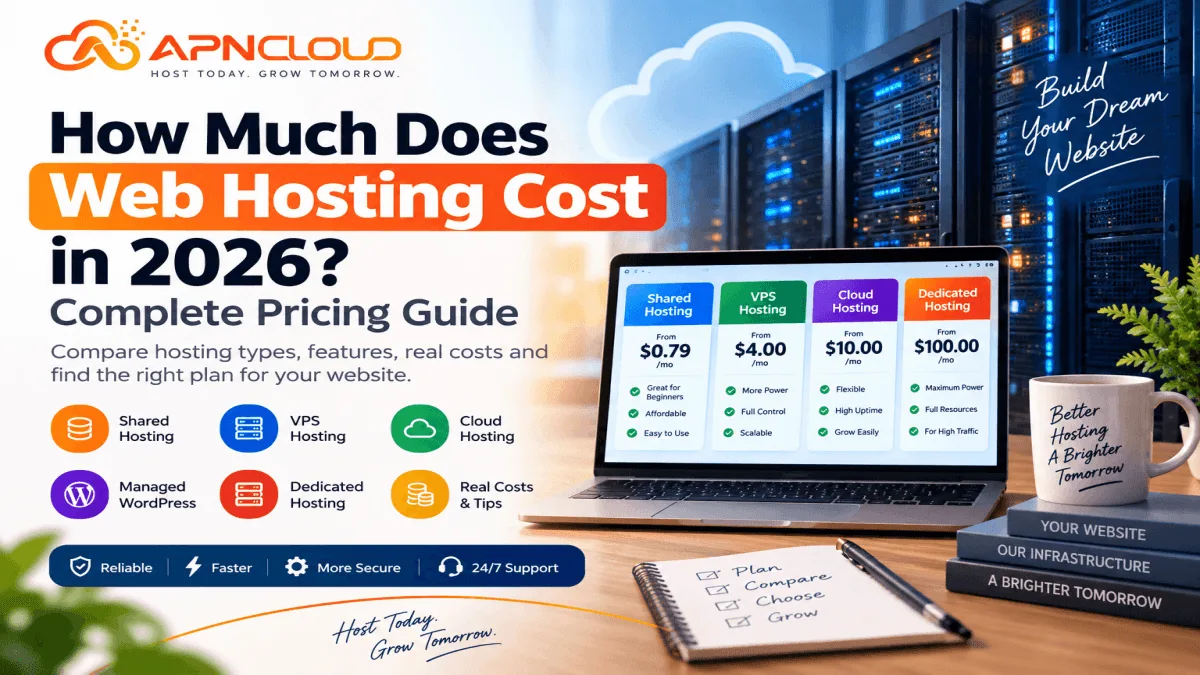
If you are planning to launch a website in 2026, one of the practical questions you will likely ask is: how much does web hosting cost? The simple answer is that hosting can cost less than a dollar per month for an entry-level shared hosting plan. It might be dollars per month for a growing business website. For a private server the price could go up to tens of dollars each month.. For managed or dedicated infrastructure the cost can get considerably higher. The more useful answer is this: the real web hosting cost depends on what your website needs. It matters how much traffic your site receives. It also matters how technical control you want. What services come with the plan plays a role too.. You must consider whether the price you see is just an introductory rate or the regular renewal price.
For beginners hosting prices can be confusing. Two plans may have monthly prices but they often offer very different amounts of storage CPU power, RAM, backups, email accounts, SSL certificates, support options, access to a control panel and overall website capacity. One provider might advertise a low price but require a long-term commitment—like three years or more. Another might charge more per month but let you pay on a shorter billing cycle. You might also find some plans include features like SSL certificates, automatic backups, website migrations, business email, security tools or a full control panel. Other providers charge extra for these things. That’s why comparing the number next to ", per month" can lead you to the wrong choice.
This complete 2026 pricing guide explains what different types of hosting normally cost, what affects hosting prices, which extra expenses you should budget for, how website performance connects with hosting resources, and how to calculate the total cost of running a website rather than focusing only on the advertised hosting fee. If you are completely new to hosting, you may also want to read What Is Web Hosting? A Complete Guide for Beginners before comparing individual plans.
How Much Does Web Hosting Cost in 2026?
I think for beginner websites the cost of web hosting in 2026 can begin at just a few dollars each month especially when shared web hosting is chosen. A personal website, a portfolio, a small blog, a landing page or a new company website usually does not need a server. Shared web hosting lets many customers share the equipment of a run server, which brings down the cost for each customer. As a planning range beginners may find shared web hosting from about $1 to $15 each month depending on the provider contract length resources included and any promotion. Advanced WordPress or e‑commerce web hosting may cost a few dollars to $20 to $50 or more each month. VPS web hosting can start at about $5 to $15 for self‑managed servers and grow significantly as CPU, RAM, storage, bandwidth, management and software licenses are added. Managed VPS web hosting services normally cost more because they include server configuration, monitoring, maintenance and technical help. Dedicated web hosting sits above VPS web hosting. Can cost tens or hundreds of dollars each month depending on the hardware and level of management.
The important point is that these are only planning ranges, not fixed industry prices. Current provider offers show why. For example Bluehost lists a Starter web hosting offer at $3.99 per month for a 36‑month term while the renewal rate for that term is $9.99 per month. DreamHost lists a first‑year web hosting offer at $2.89 per month that renews at $10.99, per month. Hostingers Bangladesh pricing also shows discounted long‑term rates that renew at standard rates. These examples show why your first‑year web hosting bill and long‑term web hosting bill can be very different.
Why Understanding Web Hosting Cost Matters
Hosting is the foundation that keeps your website running on the internet. When someone types your domain name into a browser the website files, databases, images, scripts and other content must be sent from a server. How well that server performs can have an impact on how reliable your site is, how fast it loads, how secure it stays how easily it can grow and how well it overall functions. This is why looking at the monthly price when comparing hosting plans can give a wrong impression. Two plans that cost $5 a month might actually offer different things. One might have CPU power, more memory, faster storage like SSDs, stronger backup systems, better customer support, an easier control panel or more security tools. One provider could include SSL certificates, email accounts, automatic backups, migration help and a full control panel in the price. Another might charge extra for those features.
Another key thing to consider is the difference between a price and what you’ll pay later. Introductory prices are often low. Can make starting a website feel affordable.. Customers should always find out what the renewal price will be after the first billing period ends. For example Bluehost advertises its Starter plan at $3.99 per month for 36 months.. Once that time is up the renewal rate jumps to $9.99 per month for another 36 months.
The same idea applies to VPS services. Hostinger lists its KVM 1 VPS at $6.49 per month. Shows the renewal price as $11.99 per month over a two-year term. There’s nothing with promotional pricing by itself. The trouble starts when people plan their budget based on the initial discount and don’t check the long-term cost. A smart hosting choice looks at the cost of ownership instead of just the first bill. You should look at the hosting price the renewal amount, domain registration fees, email needs, SSL certificates, backup options, control panel access, server management, migration services, security features and possible upgrades down the line. If you understand all these costs, before buying it becomes much clearer which hosting provider will work best for both your website and any future growth.
Web Hosting Cost in 2026: Quick Overview
There is no single universal price for hosting because different services solve different problems. A practical budgeting overview for 2026 looks like this:
Hosting Type | Practical Starting Budget | Best For |
|---|---|---|
Shared Hosting | Under $1 to around $15+/month | Blogs, portfolios, small businesses, beginner websites |
Managed WordPress Hosting | Around $10 to $50+/month | WordPress users wanting more management and optimization |
Self-Managed VPS | Around $4 to $50+/month | Developers, applications, growing websites |
Managed VPS | Around $13 to $100+/month | Businesses needing VPS resources without managing everything themselves |
Cloud Hosting | Around $10 to $100+/month | Growing and variable workloads |
Dedicated Hosting | Around $100 to $400+/month | High-traffic and resource-heavy projects |
Enterprise/Custom Infrastructure | Custom pricing | Large businesses and specialized applications |
These are budgeting ranges rather than fixed market prices. Hosting companies package resources differently, promotional rates change, and some plans include services that other companies sell separately. Digital Ocean, for example, currently lists basic virtual machines starting at $4 per month for a 512 MiB configuration, with larger Basic Droplets ranging upward according to RAM, vCPU, storage, and transfer capacity.
At the other end of the market, dedicated server pricing can easily reach hundreds of dollars per month. Bluehost currently lists dedicated configurations at $144.19, $220.19, and $315.19 per month on 36-month terms, with higher renewal figures displayed for those plans. The important lesson is that a $4 VPS and a $300 dedicated server are not competing versions of exactly the same product. They provide different levels of resources, isolation, responsibility, scalability, management, and performance.
What Actually Determines Web Hosting Cost?
The biggest factor is the type of hosting. Shared hosting is normally the affordable because many websites operate on a managed server environment and share the underlying infrastructure. VPS hosting separates a defined amount of server resources for each customer. Managed VPS adds administration services. Dedicated hosting assigns physical server hardware to one customer. Reseller hosting includes tools for creating hosting accounts for clients. Each additional level of isolation, resources, flexibility and management generally increases the cost. Server resources are another pricing factor. CPU capacity determines how much processing work can be handled. RAM influences how many active processes and applications can operate efficiently. Storage determines how much website data can be kept on the server. Bandwidth relates to how much data can be transferred between the server and users. Plans with allocations naturally tend to cost more.
Storage technology also matters. Traditional hard drives are cheaper but considerably slower for read and write operations than modern SSD and NVMe storage. Many current hosting providers use SSD or NVMe storage because faster disk access can improve databases, dynamic pages, administrative dashboards and overall website responsiveness. You should also compare the software and services included in the price. SSL certificates, control panels, application installers, automated backups, migration assistance, email accounts, malware scanning, caching, staging, CDN integrations, technical support and server management can all affect value. A $3 hosting plan containing several of these services may ultimately cost less, than a $2 plan where important features have to be purchased.
Shared Hosting Cost in 2026
Shared hosting is still one of the choices for beginners. The hosting provider takes care of the server, the operating system, the network and most server-level tasks. Users just get an account where they can upload websites create databases, install apps set up domains manage SSL certificates and do website tasks. All without needing to handle a full server. For new blogs small business sites, personal portfolios, educational websites, small online stores and WordPress sites shared hosting strikes a good balance between cost and ease of use. Prices in the market usually start $1 per month for basic plans and go up to $10–$20 or more for more powerful shared hosting packages. Special deals can bring prices lower for a time especially when customers commit to one, two three or four years upfront.
APN Cloud offers six shared hosting plans. The Launch Hosting plan starts at $0.79 per month or $2.29 every three months $4.49 every six months or $8.49 per year. The Starter Hosting plan is $1.79 Plus Hosting is $2.99 Business Hosting is $4.99 Professional Hosting is $7.99 and Enterprise Hosting is $12.99, per month. As you move to higher-tier plans you get website capacity faster NVMe storage, better CPU performance, more RAM increased inode limits and larger email and database allowances. You can review the current plans directly on the APN Cloud Shared Hosting page. For a beginner website, starting with the resources you actually need is generally more economical than buying the largest package immediately.
What Do You Usually Get With Shared Hosting?
When I compare shared hosting plans I look beyond storage capacity. I believe a modern shared hosting package should make common website‑management tasks simple enough for a beginner. That means shared hosting should give access to a clear control panel, database management, PHP configuration, SSL installation, backups, email tools, file management, DNS settings and an easy way to install website applications. APN Clouds current shared hosting plans offer NVMe storage DirectAdmin, LiteSpeed Enterprise Web Server, Softaculous application installation Lets Encrypt SSL, database access, FTP functionality, DNS tools, automated daily backups, HTTP/3 support, an uptime guarantee and support. Higher tiers give shared hosting resources and add functions such as Redis Object Cache, SSH/SFTP access, Git, WP‑CLI, WordPress staging and priority support depending on the package.
The reason this matters for web hosting cost is that included services have value. For example Provider A charges two dollars, per month. Requires you to buy backups and SSL separately while Provider B charges four dollars and includes both. Provider A is not automatically cheaper. The same idea applies to website migrations, control panels, email accounts, CDN services, caching technology and professional support. For beginners simplicity also has value. Spending hours each month fixing server configuration problems is a real cost even if no invoice is generated. A shared hosting environment that lets me focus on building my website of constantly troubleshooting infrastructure may be worth paying a little more for.
WordPress Hosting Cost in 2026
WordPress hosting does not always mean a different server technology. In cases it is website hosting that has been configured or optimized specifically for WordPress. Entry-level WordPress hosting can therefore be priced similarly to shared hosting while premium managed WordPress platforms may cost considerably more. A basic WordPress website can often run successfully on a shared hosting plan when the server supports modern PHP versions, MySQL or compatible databases SSL, caching and sufficient CPU and memory. This makes WordPress accessible to students, bloggers, freelancers, small companies and organizations that do not have hosting budgets.
Managed WordPress services generally cost more because the hosting provider may handle WordPress-specific tasks such, as updates, staging environments, advanced caching, performance monitoring, specialized support, automatic backups or enhanced security. For a company whose employees do not want to manage tasks the additional cost may be worthwhile. The biggest mistake is assuming that the word "WordPress" automatically makes a plan better. Compare the specifications. Check CPU resources, RAM, storage type, website limits, backup frequency, PHP configuration, caching control-panel access, email, migration policy, staging tools and support. If you run a blog an expensive managed WordPress platform may be unnecessary. If you operate a high-traffic publication or an important ecommerce business spending more for infrastructure and management may be a sensible business expense. Hosting should match the importance and workload of the website.
VPS Hosting Cost in 2026
A Virtual Private Server, usually called a VPS provides an isolated hosting environment than traditional shared hosting. Virtualization technology divides hardware into separate virtual machines allowing customers to receive defined CPU, RAM, storage, networking and operating-system access. VPS hosting is commonly used by developers, agencies, SaaS applications, larger websites, game or application servers where permitted and businesses that need control over the software environment.
Self-managed VPS hosting can start at surprisingly low prices. APN Clouds current Cloud VPS Starter plan is listed at $4.99 per month. Includes 1 vCPU core, 4 GB RAM, 50 GB NVMe SSD storage, 4 TB monthly bandwidth, one IPv4 address, full root access, Linux operating-system options, DDoS protection, a 1 Gbps port, infrastructure support and a 99.9% uptime guarantee. The Basic plan is $9.99 per month with 2 vCPU cores and 8 GB RAM while Standard is $14.99, with 4 vCPU cores and 12 GB RAM. Larger plans provide more resources. You can compare current configurations on the APN Cloud Cloud VPS Hosting page.
A low VPS price does not necessarily mean low total ownership cost, however. With an unmanaged VPS, you may be responsible for operating-system updates, security configuration, software installation, monitoring, troubleshooting, backups, application deployment, and other server-administration work. Beginners should include that responsibility when comparing VPS and shared hosting.
Managed VPS Hosting Cost
Managed VPS hosting brings together dedicated resources and extra technical support. Of handing you a server and letting you take care of all the system administration tasks on your own the hosting provider takes care of some or most of the server-level setup, maintenance, monitoring, security fixing problems and updates based on their specific management policy. Since real people do some of the work managed VPS plans usually cost more than unmanaged servers.. The price difference can still be a great deal for a business. Hiring a server administrator on your own can cost more than the monthly difference between unmanaged and managed hosting.
APN Cloud offers Managed Cloud VPS Starter for $12.99 each month. It has 1 vCPU core, 4 GB of RAM 50 GB of NVMe storage and 4 TB of bandwidth. The service covers setup and configuration security improvements, server monitoring, updates help with installing a control panel, DDoS protection and managed support. Managed Cloud VPS Basic costs $19.99 a month. Managed Cloud VPS Standard is $29.99 a month. For people who are just moving from shared hosting to a server managed VPS can help close the gap. It gives resources and more control without making the website owner into a full-time Linux administrator.. Always check the management details, from the provider carefully because "managed" can mean different things at different hosting companies.
Reseller Hosting Cost in 2026
Reseller hosting is meant for people or businesses that want to offer hosting accounts to their customers. Web developers, design agencies, IT service providers, freelancers and entrepreneurs often choose reseller hosting. This is because it lets them set up hosting accounts without buying and managing a full physical server. Pricing mainly depends on how hosting accounts you need, total storage space, bandwidth limits how resources are shared, branding tools, access to the control panel, backup systems, private nameservers and support options. Starter reseller plans can begin at than $10 per month.. If you're managing dozens or even hundreds of clients the cost goes up significantly.
APN Cloud currently offers a Reseller Starter plan for $4.99 per month. This plan allows up to 10 hosting accounts and 25 GB of NVMe storage. The Reseller Basic plan costs $8.99 per month. Includes 25 hosting accounts with 50 GB storage. The Reseller Standard plan is $14.99 per month. Supports 50 accounts with 100 GB storage. The platform also offers DirectAdmin reseller access, custom hosting packages, custom nameserver support, white-label options, LiteSpeed, free SSL certificates, Softaculous, automated backups and migration support. Reseller hosting should be seen as a business cost, not a website expense. For example if your reseller account costs $15 per month and you have 20 paying customers your infrastructure cost per customer becomes very low.. You must also think about other costs, like billing software, customer support, domain services, taxes, payment processing fees and the time you spend managing everything. These factors all affect how profitable your reseller business really is.
Dedicated Hosting Cost
Dedicated hosting gives one customer access to an entire physical server. This means the hardware is not shared with users. Since the whole machine is reserved for a client dedicated servers provide top performance lots of resources, strong isolation and the ability to customize the setup. These servers are often used by websites with traffic, large enterprise applications, database-heavy systems, specialized software, hosting providers and any workload that has outgrown VPS hosting. Dedicated hosting is usually one of the expensive options in mainstream hosting. Entry-level dedicated servers can cost a tens of dollars each month.. Powerful machines with high-core CPUs plenty of ECC memory multiple NVMe drives, fast networking, managed support, backup systems, software licenses and extra IP addresses can easily cost hundreds or even thousands of dollars every month.
For a business website buying a dedicated server usually doesn’t make much financial sense. You’d be paying for hardware that you might not fully use while also dealing with complex management tasks. Shared hosting or VPS hosting offers an more affordable path for growth. Dedicated servers start to make sense when the business has reasons for needing them. For example if you regularly use a lot of CPU power run databases need strict isolation between services do heavy background work run high-volume applications or require custom hardware setups then a dedicated server may be the right choice. Don’t switch to dedicated hosting just because it sounds more professional. The goal should be to find a hosting solution that reliably supports your application while staying cost-effective. A configured VPS or a business-grade shared hosting plan can often perform better, than a large but poorly managed dedicated server.
Ecommerce Hosting Cost
When I think about hosting for an ecommerce store I see that it needs a budget than a basic informational website. An ecommerce store does more work. Product pages, customer sessions, search, shopping carts database queries, payment integrations, inventory systems, administrative dashboards, plugins, images and order‑processing tasks all use resources. A small WooCommerce or similar ecommerce store can run on a decent shared hosting package.. As the catalogue visitors, plugins and orders grow, more CPU, RAM, caching, database speed and storage may be needed. A growing ecommerce store will then move from shared hosting to a shared plan a managed WordPress platform, a VPS, a managed VPS or a cloud environment.
When I calculate ecommerce web hosting cost I make sure to include reliability and support not just pick the plan. If a regular blog is down for thirty minutes the trouble is small.. If an ecommerce store goes offline during a busy sales period the business can lose orders and customer confidence. Security also deserves attention. Free SSL is enough for HTTPS encryption in normal situations but the hosting environment still needs updates, backups, secure configurations, sensible account permissions and application‑level security. For ecommerce businesses spending ten to thirty dollars more per month on infrastructure may be small compared with the revenue that better stability protects. The correct hosting budget should be based on business value, not the number of pages, on the website. You can compare current configurations on the APN Cloud Ecommerce Hosting page.
Domain Name Cost Is Separate From Hosting
A domain name and web hosting are. Different things. Your domain is the easy to read address people type into a browser while hosting is the system that makes the website work. Some hosting deals offer a domain for the year but that does not mean domains are free forever. Popular endings like.com,.net and.org usually need you to pay every year to keep them. Costs change depending on the company you use the ending you choose what the group that manages the ending charges, taxes, money type, special offers and extra options.
APN Cloud shows.com registration at $8.00 each year.net at $13.15 each year. At $8.39 each year on its website. You should always check the domain availability and cost before buying because the rules for registration can change. If you buy an $8.49 hosting plan and an $8 domain for instance your system cost is not $8.49 each year; it is at least $16.49 before any other options. The difference is small in this case. Knowing the difference helps avoid unexpected bills later. Also look at the cost to renew the domain. Companies sometimes have prices for the first year and higher prices after that. Since a business usually wants to keep the domain for many years the cost to renew is more important, than a short-term discount.
SSL Certificate Cost
SSL certificates allow HTTPS encryption between a website and its visitors. I see that most ordinary websites should use HTTPS in 2026. Modern browsers look for connections. Customers look for security icons. Many applications need HTTPS to work. The good news is that SSL does not always cost extra for hosting. Free certificate providers such as Lets Encrypt give domain‑validated SSL certificates. Many hosts give SSL automatically with their hosting plans.
APN Cloud gives Lets Encrypt SSL certificates in its hosting packages. That means a beginner on those plans does not need to buy a standard SSL certificate just to use HTTPS. Commercial SSL certificates still. May fit when an organization needs a special validation level, warranty, certificate type or enterprise certificate‑management solution. I think we should evaluate these products based on business needs not because someone says every site needs a certificate. When comparing host prices check if SSL is inside the price and if renewal stays free. A cheap host that later asks for paid SSL can be less appealing, than a plan where certificates stay free.
Email Hosting Can Change Your Total Budget
Business email is another cost that people often forget about. Some shared hosting plans let you set up email addresses from the control panel but other hosting services don't have email at all. Companies might also want an email service for more space, better tools to work together better spam protection, easier management or to keep website and email separate. Before you get hosting figure out how email addresses you need. A person who works on their own might need one address like [email protected]. A small business might need addresses for sales, support, billing, managers and each employee. A company that is growing might need many or even hundreds of email accounts.
If your hosting plan has the email accounts you might not have to pay anything extra. If you pick a business email service you need to calculate the cost per user every month or every year. It is also an idea to think about what happens when things change. Keeping email separate from web hosting can make moving to a service easier because you don't have to move all your email addresses at the same time.. Having basic email with a shared hosting plan can be easy to use and not expensive, for people who are just starting out. The best choice depends on your company. The main thing to remember is that website hosting and professional email are not always the thing.
Backup Costs and Why They Matter
Backups are one of the important services to look at before choosing a hosting provider. Websites can be damaged by failed updates, software bugs, accidental deletion, compromised accounts, database problems, plugin conflicts, malware or human errors. A good backup gives you a way to bring the website back of having to build everything from scratch. Some companies charge extra for automated backups. Others offer them with packages. APN Clouds current shared hosting plans show automated backups with one-click restoration available on its packages.
Even if hosting includes backups important business websites should know the providers policy. Look at how backups are done how long they are kept, how to restore them what is not backed up the largest account size allowed and if backups are kept separate from the main system. For projects having an independent off-site backup might also be a good idea. Think about backup costs in terms of risk of just storage space. Paying a dollars each month for a solid backup system is usually much less expensive than paying a developer to fix a deleted e-commerce site, database or customer area. When two hosting plans have prices better backup features can be more helpful, than getting a few extra gigabytes of storage that your website might never need.
Control Panel and Software License Costs
Hosting control panels make managing a website easier. Of using a command-line interface for each task users can handle domains, databases, email accounts, SSL certificates, DNS records, files, FTP accounts, cron jobs, backups and other services, through a visual interface. Different systems use control panels and some commercial panels come with license fees. On managed hosting this cost is often included in the hosting price. On VPS or dedicated servers you might need to buy a control-panel license depending on the product you choose.
APN Cloud. Reseller hosting use DirectAdmin right now while its VPS options give full server access and control-panel choices may vary based on the server or management service. The same idea applies to software licenses. Your server might need paid software, security software, e-commerce plugins, premium WordPress themes, monitoring services, database tools or application licenses.
A $10 unmanaged VPS can then turn into a $30 or $50 cost once licenses and management are added. This is another reason why beginners should not just compare hosting products based on the infrastructure price. Always consider the whole software stack needed to run the website correctly.
How Website Performance Affects Hosting Cost
Better hosting can't fix every performance problem. A website that isn't optimized and has big images, slow plugins, extra scripts, bad database queries or too much third-party tracking might still be slow even if the hosting is very expensive.. Hosting resources are the base that optimization works on. CPU power affects how PHP runs how the database works, how application processes handle tasks how compression happens and how pages are made dynamically. RAM helps the operating system, the database, PHP workers, caching services and applications deal with requests at the same time. Fast NVMe storage makes it quicker to read files and do database tasks that need a lot of disk activity. Good network quality makes it faster for data to leave the server and get to visitors.
As more people visit the site keeping performance often means needing more resources. That's one reason why web hosting costs usually go up when a website becomes more popular. The goal isn't to buy the resources right away. Instead watch how much you're using. If the CPU is always at the top of its limits if memory is always gone if database requests are slow or if more visitors cause slow response times even after the application is optimized then maybe an upgrade is needed. A hosting provider that can grow with you should let you move from hosting plans to more powerful shared hosting, VPS managed VPS or a dedicated server as the needs grow. Paying for growth when it happens is usually better for money, than buying much at the start.
Introductory Price vs Renewal Price
A main lesson from this pricing guide is that the hosting prices people see in ads are usually just introductory promotions, not the true long‑term cost. The discount often only works for customers and only during the first term they purchase. Bluehost shows Starter hosting at $3.99 a month for a 36‑month contract.. The same page says that when you renew after the 36 months the price jumps to $9.99 a month. DreamHost offers a Launch plan at $2.89 a month for the year but renewal is $10.99 a month. Hostinger in Bangladesh shows long‑term deals that rise when you renew.
Introductory pricing is fine. A real promotion can save a lot. The problem is when people use the low price to plan their budget for many years. Before you buy write down four numbers: the monthly price, the total money you pay at checkout how long the first term lasts and the renewal price. Also check if domain registration, email, backups, premium security or other services change when you renew. If you run a business site that will stay online for years the renewal rate is usually more important, than the first‑year discount.
Monthly vs Annual Hosting: Which Is Cheaper?
When I look at billing cycles I see that the monthly cost can become lower. That happens because the hosting provider gets paid ahead of time and cuts down on paperwork or on the cost of gaining customers. Offering one year two years, three years or four years of hosting can therefore seem cheaper than paying each month. The downside to these billing cycles is that you commit. Paying for three years means you spend money at once and you stay with the hosting provider unless you can get a refund. A beginner who is still testing an idea might choose quarterly billing even if the monthly equivalent is a bit higher. When the website grows and the hosting service proves reliable moving to a term can lower the average cost.
APN Cloud still has quarterly, semi‑annual and annual billing choices for its shared hosting plans. For example Launch Hosting is listed at $0.79 each month or $8.49 a year while Business Hosting costs $4.99 each month or $49.99 a year. Compare the price instead of just multiplying the advertised monthly figure. Some hosting providers show an equivalent but actually charge the full, one‑, three‑ or four‑year amount when you check out. Also look at the refund terms before you make a commitment. The cheapest annual price only matters if the hosting provider meets your needs.
Step-by-Step Guide: Calculate Your Web Hosting Budget
Step 1: Identify the Website Type
Start by defining exactly what you are building. A one-page portfolio, school project, company website, WordPress blog, ecommerce store, agency website, customer portal, SaaS application, or high-traffic publication will have very different resource requirements. For a normal beginner business website, shared hosting is generally the first category to investigate. If the website runs custom server software, requires root access, needs isolated resources, or already receives significant traffic, VPS hosting may make more sense. Do not choose hosting according to what you might need five years from now. Choose enough resources for today with a clear upgrade path for tomorrow.
Step 2: Estimate the Number of Websites
Hosting plans often limit the number of websites or domains you can host. If you need only one website, paying extra for a package supporting hundreds of sites provides little immediate value. Agencies and developers should think differently. If you manage ten or twenty customer websites, a larger shared package or reseller account can reduce the average hosting cost per site.
Step 3: Estimate Storage Requirements
Most small websites do not require enormous amounts of disk space. A typical WordPress installation with optimized images can operate comfortably within modest storage limits. Video-heavy sites, backup repositories, file-sharing platforms, and websites containing thousands of high-resolution images require more. Avoid using storage size as the only comparison metric. Fast NVMe storage, CPU allocation, RAM, inode limits, backup systems, and database performance may be more important than receiving hundreds of gigabytes you never use.
Step 4: Estimate Traffic and Processing Requirements
Traffic matters, but the type of request matters too. Ten thousand visitors viewing cached HTML pages can require fewer server resources than a much smaller number of visitors running complex searches, ecommerce filters, database operations, or dynamic dashboards. If you are starting a new website with no traffic history, begin conservatively and monitor usage. Upgrading later is usually easier than recovering money spent on unused resources.
Step 5: Add Essential Services
Calculate your domain, SSL, backups, email, premium software, migration, monitoring, security, and developer costs. If the hosting package includes some of these, mark their additional cost as zero.
Step 6: Check Renewal Pricing
Never finish a hosting comparison until you know the renewal cost. Calculate at least a three-year budget so a temporary discount does not distort your decision.
Step 7: Compare Support and Upgrade Options
Finally, ask what happens when your website grows. Can the hosting provider upgrade the account without unnecessary downtime? Is VPS available? Is managed server support available? Can backups be restored easily? Is support available when you need it?
For more detail on evaluating these factors, read How to Choose the Best Web Hosting for Your Website in 2026.
Example Budget: Personal Blog or Portfolio
I think a new personal blog or portfolio is one of the websites to host. All you need is one domain, one hosting account, SSL, an email accounts and WordPress or another free content‑management system. I believe a reasonable first‑year infrastructure budget can therefore remain very low. If the hosting plan costs between ten dollars and fifty dollars a year and the domain costs eight to twenty dollars depending on the extension and registrar the basic annual infrastructure bill may be below seventy dollars. Premium themes, plugins, professional email or development services would increase the total. They are optional for many beginner projects.
APN Clouds current Launch Hosting annual rate of eight dollars and forty‑nine cents illustrates how inexpensive entry‑level hosting can be although you should always check renewal terms and specifications before purchasing. Do not let the low budget encourage you to ignore backup and security practices. Even a personal blog may represent hundreds of hours of writing, photography, design work or research. The best plan is therefore not the cheapest package. Look for a provider that offers a management panel, SSL, backups, responsive support and enough resources, for normal WordPress or static‑site operation.
Example Budget: Small Business Website
A small business website is usually more important than a project. Customers look at the website to evaluate the company discover services find contact details, request quotations, book appointments and make purchases. A business might set aside about fifty to two hundred dollars each year for shared website hosting and domain infrastructure depending on the chosen resources. Included features. Extra costs could involve email, premium plugins, booking software, security tools, website maintenance or developer support.
For example APN Cloud offers a Business Hosting plan for forty-nine dollars and ninety-nine cents per year. This plan can host up to fifty websites. Provides one hundred gigabytes of NVMe storage four vCPU cores, four gigabytes of RAM, free SSL, DirectAdmin, LiteSpeed, automated daily backups, Redis Object Cache, SSH, Git, WP-CLI and other listed features. That does not mean every business needs that plan. A smaller company website might use a tier. The example simply shows how business‑grade shared hosting can stay affordable compared with operating expenses, such as advertising, accounting software, payment processing or office services. For a business it is better to evaluate cost in relation, to reliability. The customer experience, rather than to look for the lowest possible invoice.
Example Budget: Growing Ecommerce Store
A new ecommerce store may start on shared hosting, but its hosting requirements can increase more rapidly than those of a simple corporate website. Product databases, customer accounts, orders, payment integrations, plugins, background jobs, search, inventory, images, and traffic spikes create additional workload. For a small store, budgeting around $100–$300 per year for hosting and domain infrastructure can provide room to choose a strong shared hosting or entry managed platform. As traffic grows, costs may move into the $20–$100+ monthly range if VPS or managed VPS resources become necessary.
The exact number is less important than measuring performance. Monitor page-load time, CPU usage, memory, database response, PHP workers, error logs, checkout performance, and uptime. If the store generates substantial revenue, paying for infrastructure that keeps it responsive is usually a sensible investment. Also budget for independent backups where appropriate, premium ecommerce extensions, transactional email, security monitoring, and developer maintenance. Do not automatically upgrade because someone recommends “VPS for ecommerce.” A well-optimized small store can run efficiently on suitable shared hosting. Conversely, do not remain on an underpowered shared account simply to save a few dollars if slow checkout pages are costing sales.
Example Budget: Developer or Growing Application
Developers who run custom applications often get a lot of benefits from VPS hosting because they need control over the operating system the web server, the runtime versions, the databases the queues, the containers, the firewall rules or the deployment process. A self-managed VPS can start at $5 to $15 each month which means server-level control is something even small projects can get. APN Clouds current VPS Starter, Basic and Standard plans are in that price range costing $4.99, $9.99 and $14.99 each month. A development team should plan for the engineering time needed. A $5 server that takes hours of administration each month can actually cost more for a business than a $20 managed service.
Applications also tend to bring in infrastructure needs as they grow:, off-site backups, monitoring, transactional email, object storage, CDN services more IPv4 addresses, database replication, staging environments log management or external APIs. That is why infrastructure planning should keep the base server cost from the total application operating cost. This helps make it clearer which costs will go up as usage increases.
Common Mistakes When Comparing Web Hosting Prices
The first mistake is picking a hosting provider only because that hosting provider shows the price. Low prices can be real but you still need to know what resources and services are part of that hosting provider’s plan. I have seen many people make this mistake. The second mistake is ignoring renewals. A discounted first term can make one hosting provider look far cheaper even though another hosting provider costs less over three or five years. I have seen people ignore renewals and end up paying later. Third beginners often pay for resources they will never use. A new five‑page company website does not need enterprise infrastructure just because a larger plan looks more impressive. I have seen beginners overpay for features they will never touch.
The opposite mistake is just as common: staying on an entry‑level plan after the website clearly needs resources. Saving a few dollars is not worth it if pages become slow or if resource limits keep cutting off service. I have seen people stuck on entry‑level plans and lose traffic because of speed issues. Another mistake is ignoring backups. Customers usually think about backups only after data has been deleted. I have seen customers forget to set up backups until something is lost. Do not forget support either. If the website is important to your business the ability to get technical assistance can be worth more than a tiny price difference. I have seen businesses overlook support and face problems.
Finally avoid comparing unlike products. Shared hosting, managed WordPress hosting, VPS managed VPS, reseller hosting and dedicated servers solve different problems. A $5 shared plan is not better value, than a $10 VPS and the VPS is not automatically better just because it gives root access. Value depends on what you need. I have seen people compare unlike products and make choices.
How APN Cloud Approaches Affordable Website Hosting
APN Cloud offers a path that starts with inexpensive shared hosting. From there APN Cloud extends into Cloud VPS, Managed Cloud VPS, reseller hosting and dedicated infrastructure. This gives a website a simple plan to start and later move to stronger resources instead of buying more server capacity than needed from day one. The shared hosting platform uses NVMe storage, DirectAdmin, LiteSpeed Enterprise, Softaculous free Let’s Encrypt SSL, automated daily backups and multiple billing cycles. Launch Hosting starts at $0.79 per month. Larger shared plans are also available for websites that need storage, CPU, RAM, website capacity and advanced tools.
Businesses and developers that need server-level control can move to Cloud VPS hosting. The Starter plan for Cloud VPS is priced at $4.99 per month. Customers who need server-management help can consider Managed Cloud VPS services, which start at $12.99, per month. The main benefit of hosting categories is flexibility. You do not need to predict your websites future traffic before launch. Begin with a package monitor website performance and resource usage and upgrade when real data shows that more capacity is needed.
Is Cheap Web Hosting Bad?
Cheap hosting is not always bad as expensive hosting is not always good. Hosting prices depend on things like the infrastructure how automated the system is, where the company is located how much it costs the company to run how they get new customers how long the contract is, how their support works how well they use their hardware and many other factors. An inexpensive shared hosting service can offer service for a small website if the company takes care of its servers and gives customers enough resources to work with. Shared hosting works because a lot of websites don't need their own whole server.
Issues happen when a hosting plan doesn't have resources for the work needed or when cutting costs hurts the quality of service. Red flags can be software, very strict limits, on resources, bad backups, slow support, lots of unexpected downtime busy servers, confusing bills or too much pushing to buy more. Of asking "Is this hosting too cheap?" ask "Does this hosting give what my website needs?" Look at the storage type how much CPU and memory is available the backup rules how much uptime there is, the control panel, the software versions, SSL, technical help options to upgrade the billing terms and the customer rules. For someone just starting out cheap hosting can be the choice. The goal is not to spend money it is to spend money wisely.
When Should You Pay More for Hosting?
Pay more when extra spending solves a technical or business problem. If your website regularly reaches CPU or memory limits even though it is properly optimized extra server resources can improve stability. If your database has grown significantly a VPS or larger plan might give performance. If website has become business‑critical, managed services can reduce risk. If you need root access or custom server software VPS hosting offers functionality that normal shared hosting cannot.
You may also justify a hosting budget when website generates meaningful revenue. Consider an ecommerce store earning thousands of dollars every month. Saving $10 by using a hosting environment would make little sense if slow pages or downtime causes lost orders. The same principle applies to agencies. If you host twenty client websites, better backup, management and support services can protect both revenue and professional reputation. Paying more without a reason is unnecessary. Refusing to upgrade when website has clearly outgrown websites existing environment can be equally costly. Hosting should scale with value, complexity and workload of the project.
Final Thoughts: How Much Should You Budget for Web Hosting in 2026?
There is no one web hosting cost for all websites. In 2026 new people can still create websites for just a few dollars each month but big apps and business platforms can need much bigger budgets for their infrastructure. For a blog a portfolio or a small business site shared hosting is usually the best place to start. It gives a cost managed setup without needing to know how to manage servers. Bigger sites might go to shared options or VPS hosting. Programmers who want control over their servers can go with self-managed VPS. Companies that want their resources without doing all the work can look into managed VPS hosting. When the amount of work justifies it dedicated servers are the choice.
The important thing is to look at the total value, not just the lowest price shown each month. Check the prices when they renew the CPU and memory the storage type, SSL, backups help with moving sites, control panels, email, support how time the site stays up and the cost of upgrades later. APN Cloud now has shared hosting starting at $0.79 each month Cloud VPS starting at $4.99 each month and Managed Cloud VPS starting at $12.99 each month. These options give starting points depending on how many resources and how much management you need. Pick the hosting plan that works well for your website now and also lets you grow. Being smart with your money on hosting is more important, than taking the cheapest option or paying for things you do not need. To compare current options, visit APN Cloud hosting plans and select the package that matches your website's current requirements.
Frequently Asked Questions About Web Hosting Cost
1. How much does web hosting cost per month in 2026?
Web hosting can cost anywhere from less than $1 per month for highly affordable entry-level shared hosting to hundreds of dollars per month for powerful managed or dedicated infrastructure. Most beginner websites can start with shared hosting costing only a few dollars per month. The final price depends on storage, CPU, RAM, website capacity, backups, support, contract length, and other features.
2. What is the cheapest type of web hosting?
Shared hosting is usually the cheapest mainstream hosting option because multiple customers use a managed server environment and share the underlying infrastructure. It is well suited to blogs, portfolios, small company websites, and many new WordPress projects.
3. How much does APN Cloud shared hosting cost?
At the time this guide was reviewed in September 2026, APN Cloud Launch Hosting was listed at $0.79 per month, Starter Hosting at $1.79, Plus Hosting at $2.99, Business Hosting at $4.99, Professional Hosting at $7.99, and Enterprise Hosting at $12.99 per month. Pricing can change, so confirm the latest amount before ordering.
4. Does web hosting include a domain name?
Not always. A domain and hosting are separate products, although some providers bundle domain registration with selected plans or promotions. Always check both the first-year domain price and the renewal price.
5. Do I need to pay for SSL separately?
Not necessarily. Many hosting providers include free SSL certificates. APN Cloud currently includes Let's Encrypt SSL certificates with its shared hosting plans.
6. Why does hosting become more expensive when it renews?
Many providers use introductory promotions for new customers. When the promotional term ends, the hosting service renews at its normal rate. This is why you should check renewal pricing before making a long-term hosting decision.
7. Is monthly hosting better than yearly hosting?
Monthly billing offers flexibility and requires a smaller upfront payment. Annual or multi-year plans often provide a lower average monthly price. Beginners testing a project may prefer shorter billing cycles, while established websites can potentially save money with longer terms.
8. Is VPS hosting more expensive than shared hosting?
Usually, yes, because VPS hosting provides isolated virtual-server resources and greater control. However, entry-level VPS servers can still be affordable. APN Cloud's current Cloud VPS Starter plan is listed at $4.99 per month.
9. What is the difference between managed and unmanaged VPS pricing?
An unmanaged VPS primarily provides server infrastructure, while the customer handles much of the operating-system and application administration. Managed VPS plans cost more because server setup, maintenance, monitoring, updates, hardening, or technical assistance may be included according to the provider's management policy.
10. Should a beginner choose shared hosting or VPS?
Most beginners launching a normal website should begin with shared hosting because the hosting provider handles server-level administration. VPS hosting becomes useful when you need root access, custom server software, dedicated virtual resources, or greater control. You can also review APN Cloud's guide to choosing the right hosting before deciding.
11. Can better hosting improve website performance?
Yes, especially when the existing account is limited by CPU, RAM, disk speed, database performance, or concurrent-processing capacity. However, hosting cannot replace proper website optimization. Images, plugins, scripts, caching, themes, databases, and application code also affect website performance.
12. How much should a small business budget for hosting?
Many small business websites can operate comfortably with an annual infrastructure budget of approximately $50–$200 for hosting and domain services, depending on the requirements. Businesses using premium email, ecommerce tools, development support, or managed servers should budget more.
13. Are unlimited hosting plans really unlimited?
“Unlimited” or “unmetered” services normally remain subject to provider policies, server-resource limitations, acceptable-use rules, or fair-use conditions. Always read the plan specifications and terms rather than assuming unlimited means infinite resources.
14. Should I choose the cheapest hosting plan available?
Choose the cheapest plan that properly meets your requirements, not simply the cheapest plan on the internet. Check resources, storage technology, SSL, backups, uptime, support, renewal pricing, control panel, migration options, and scalability.
15. Where can I learn more about choosing a hosting provider?
If you are still comparing hosting types, features, security, storage, support, and performance, read APN Cloud's guide to choosing the best web hosting in 2026 for a more detailed comparison.
Ready to Choose Your Hosting Plan?
Your website does not need the expensive server available. Your website needs hosting that matches its workload provides the features you depend on and offers an upgrade path as your audience grows. APN Cloud provides shared hosting for beginner websites and businesses Cloud VPS, for customers who need server-level control and managed server options for projects requiring additional technical assistance.
Review your requirements calculate your annual cost compare the features included with each package and choose infrastructure that supports both your current website and realistic future growth. Start by comparing the current APN Cloud Shared Hosting plans and build your website on a hosting plan that fits your actual needs.
Further Reading
Keep reading
Related articles
VPS Hosting for WordPress: Is It Better Than Shared Hosting?
Discover whether VPS hosting for WordPress is better than shared hosting. Compare speed, security, costs, scalability, and features to choose wisely.

How to Choose the Right VPS Hosting Plan for Your Website
Learn how to choose VPS hosting for your website. Compare CPU, RAM, storage, managed plans, security, pricing, and scalability before you buy.

How Much RAM Do You Need for a VPS Server? Complete Guide
Understand VPS RAM requirements and learn how much memory your server needs. Compare 1GB to 16GB VPS plans, improve performance, and choose the right RAM.
Never miss a post
Fresh guides, product updates and hosting resources from the APN Cloud team.